Article Information:
-
Stacie Jenkins, RN, MSN, CPSO
Vice President, Patient Safety and Risk
Post Date:
12/22/2025
Article Categories:
- Employee Health & Safety
- Patient Safety

The Critical Importance of Safe Patient Handling & Mobility Programs in Hospitals
Manual patient handling remains one of the top causes of staff injuries in hospitals, impacting both patient safety and the bottom line.
In our latest article, see how LHA Trust Funds is helping hospitals reduce injuries, strengthen safety culture, and sustain long-term results through new Safe Patient Handling and Mobility Programs.

In the physically demanding environment of healthcare, ensuring the safety of both patients and caregivers is paramount. One of the most pressing challenges hospitals face today is the risk of injury associated with manual patient handling.
These injuries not only compromise the health and well-being of healthcare workers but also affect patient outcomes, staff retention, and hospital finances. Implementing a Safe Patient Handling and Mobility (SPHM) program is no longer optional for facilities. It is essential.
But despite widespread recognition of the benefits, many hospitals struggle to fully implement Safe Patient Handling & Mobility Programs. Common barriers include limited funding, lack of leadership buy-in, and inconsistent staff training. Overcoming these challenges requires aligning policies with organizational goals, securing administrative support, and ensuring continuous education for frontline professionals.
The National Scope of the Problem
Healthcare workers, particularly nurses and nursing assistants, experience some of the highest rates of work-related musculoskeletal disorders in the U.S. According to OSHA, hospitals report nearly three times the rate of work-related injuries and illnesses compared to all other industries. Manual patient handling tasks such as lifting, transferring, and repositioning account for the majority of these injuries.
The financial impact of this is staggering. The direct and indirect costs associated with back injuries alone in healthcare are estimated to be $20 billion annually. These costs include medical expenses, disability compensation, litigation, absenteeism, and turnover. The Centers for Disease Control and Prevention (CDC) highlights that overexertion injuries are especially prevalent among nursing assistants and registered nurses, with back and shoulder injuries being the most common.
Hospitals report nearly 3x the rate of work-related injuries and illnesses compared to other industries. (Source: OSHA)
A Promising Decline in Claims for SPHM at LHA Trust Funds
Overall, hospitals that invest in Safe Patient Handling & Mobility Programs often see measurable returns. Reduced workers’ compensation claims, lower turnover, and fewer lost workdays translate into significant cost savings for organizations. In addition, improved patient outcomes enhance satisfaction scores and accreditation readiness.
Recent data from a five-year internal review (2020–2024) shows a notable decline in patient handling-related claims:
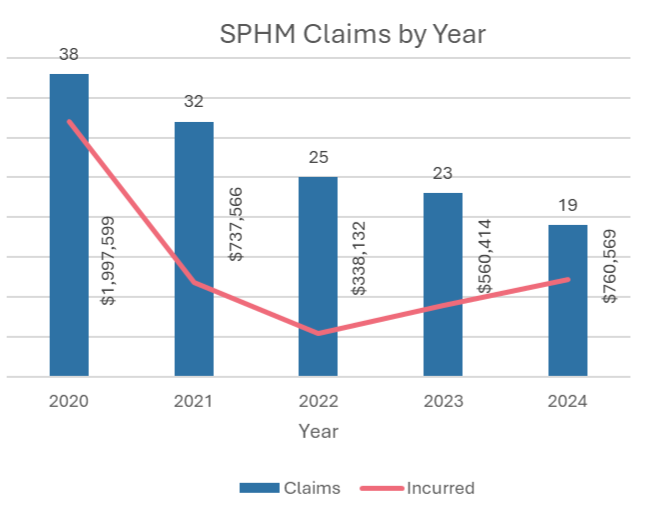
This downward trend in claims suggests that interventions and safety programs are making a measurable impact. The costs incurred remain variable but have been reduced by $1.2 million over the last five years. This indicates that, while fewer incidents are occurring, some are still severe or complex.
How LHATF Took Action to Help Members Reduce Employee Injuries Through a Safe Patient Handling and Mobility Initiative
In response to the persistent challenge of employee injuries related to patient handling, in 2021, LHA Trust Funds launched a comprehensive initiative aimed at improving safety and reducing risk across member hospitals. Recognizing the physical demands placed on healthcare workers, especially in patient handling and mobility tasks, our team implemented a multi-pronged strategy to address the root causes and support sustainable change.
A critical component of this initiative has been the use of Workplace Safety Funds, which hospitals can allocate toward building, enhancing, and sustaining their own Safe Patient Handling and Mobility programs. These funds allow organizations to invest in equipment, training, and resources that directly reduce staff injuries and improve patient care.
To date, member hospitals have used their Workplace Safety Funds to:
- Purchase mechanical lifts, transfer devices, and ergonomic tools
- Fund hands-on staff training and simulation exercises
- Develop and implement evidence-based policies and workflows
- Support ongoing monitoring, assessment, program evaluations, and more
Here’s how the initiative took shape and helped impact each of our participating member organizations:
1. Starting with a Strategic, Data-Driven Approach
The initiative began with a risk assessment, allowing members to identify high-risk areas and patterns of injury across facilities. This foundational step informed the development of a customized report with actionable recommendations, tailored to each hospital’s unique environment and needs.
2. Delivering Hands-On Support & Education
To ensure that recommendations were put into practice, we provided 1:1 consulting with hospital teams. These personalized sessions helped bridge the gap between policy and implementation, offering expert guidance on equipment use, workflow redesign, and staff engagement.
This education was a cornerstone of the initiative, which was complemented by product demonstrations that allowed teams to explore and evaluate assistive technologies, such as mechanical lifts and transfer devices.
3. Providing Tools for Long-Term Success
Understanding that sustainable change requires ongoing support, LHATF distributed a suite of resources, including:
- Sample policies to guide safe patient handling practices
- Sample measurements to track progress and outcomes
- Sample assessment tools to evaluate patient mobility and staff risk
- A toolkit with practical resources for implementation
4. Instilling a Culture of Safety
To foster a shared understanding and commitment to safety, LHATF hosted an 8-part webinar series on developing and sustaining a Safe Patient Handling and Mobility (SPHM) Program. The series was provided by Susan Gallagher, author of the book titled Implementation Guide to the Safe Patient Handling and Mobility: Interprofessional National Standards. These sessions emphasized the importance of leadership buy-in, interdisciplinary collaboration, and continuous improvement.
Additionally, LHATF promoted the ANA Interprofessional Standards on SPHM, aligning member hospitals with nationally recognized best practices and reinforcing the importance of evidence-based care.
Why Safe Patient Handling & Mobility Programs Matter
Safe Patient Handling & Mobility Programs are designed to reduce the physical strain on healthcare workers by integrating ergonomic principles, assistive technologies, and evidence-based protocols into daily patient care routines. These programs are not just about equipment, they represent a cultural shift toward safety, prevention, and respect for both patients and staff.
Key Benefits:
- Reduced injury rates among staff
- Improved patient outcomes, including fewer falls and pressure ulcers
- Enhanced staff morale and retention
- Lower workers’ compensation costs
- Increased patient satisfaction
Improve Safety Today with LHA Trust Funds
Through a thoughtful blend of assessment, education, consultation, and resource sharing, our team has empowered hospitals to make meaningful strides in reducing employee injuries related to patient handling. The initiatives in place today serve as models for how healthcare organizations can proactively address safety challenges and build a resilient, supportive environment for both caregivers and patients.
Ready to reinforce your safety program? Learn more about how LHA Trust Funds can help your organization.